Travel intelligence · iOS

Know Before Your Arrival

Velora reads a city the way someone who lives there would. Safety, money, entry rules, nightlife, the parts of town that fit you, handed back as one brief before you book anything.

Use email instead

Signed in as

Your Velora ID is claimed and your place in line is held. Velora will email you the moment the app lands on iOS.

Your account

Static sky presets. Inside the app the Atmosphere Engine composes the real sky from the destination's own light, hour and weather.

The Atmosphere Engine, running here, not a picture of it. Each sky is computed from that place's real coordinates, local hour and weather report, by the same code that runs inside the app.

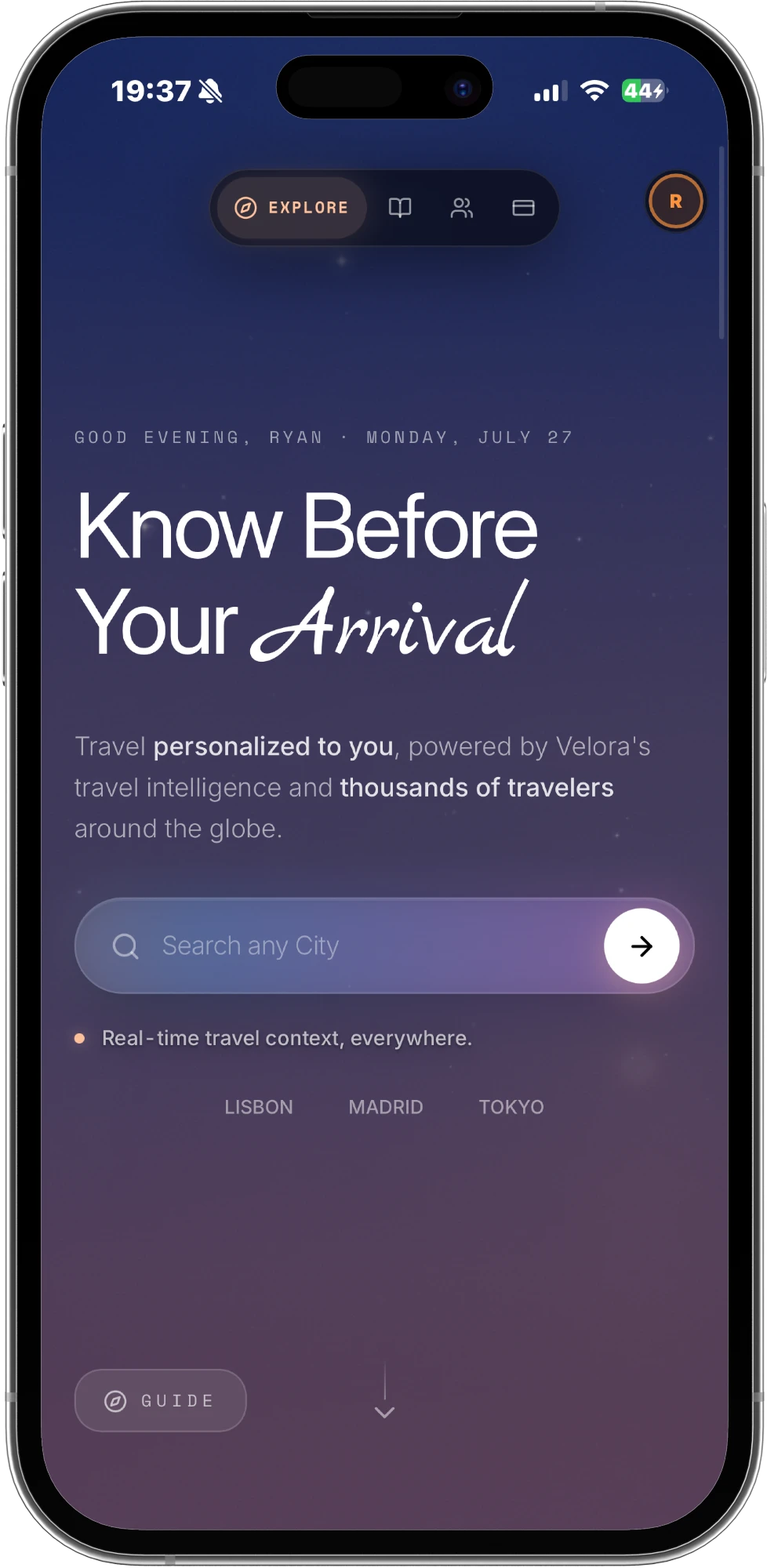
  1. Velora's home screen: a greeting, the headline Know Before Your Arrival, and a single search field reading Search any City.

    One field

    Name a city. Velora does the reading.
    No itinerary builder, no trip wizard, no ten open tabs. One field, anywhere on earth, and a brief assembled the moment you ask for it.

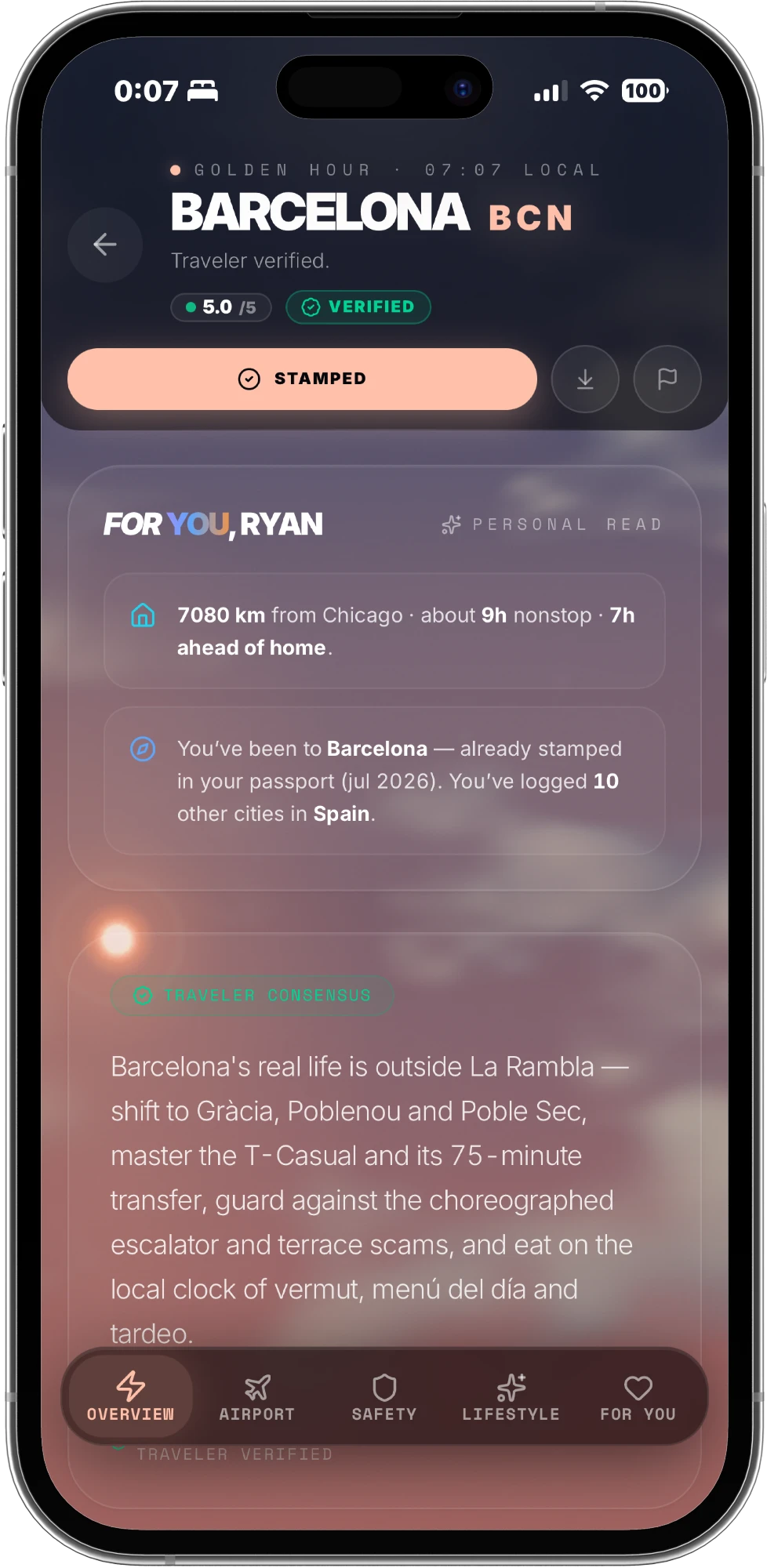
  2. A city brief for Barcelona at golden hour: a traveler-verified rating, distance and flight time from the reader's home city, and a traveler consensus paragraph about which neighbourhoods to shift to.

    The brief

    One search. Everything about it.

    Safety, money, entry rules, nightlife, the districts that suit you. Read against your passport and your home base, and it shows the confidence behind every call instead of hiding it.

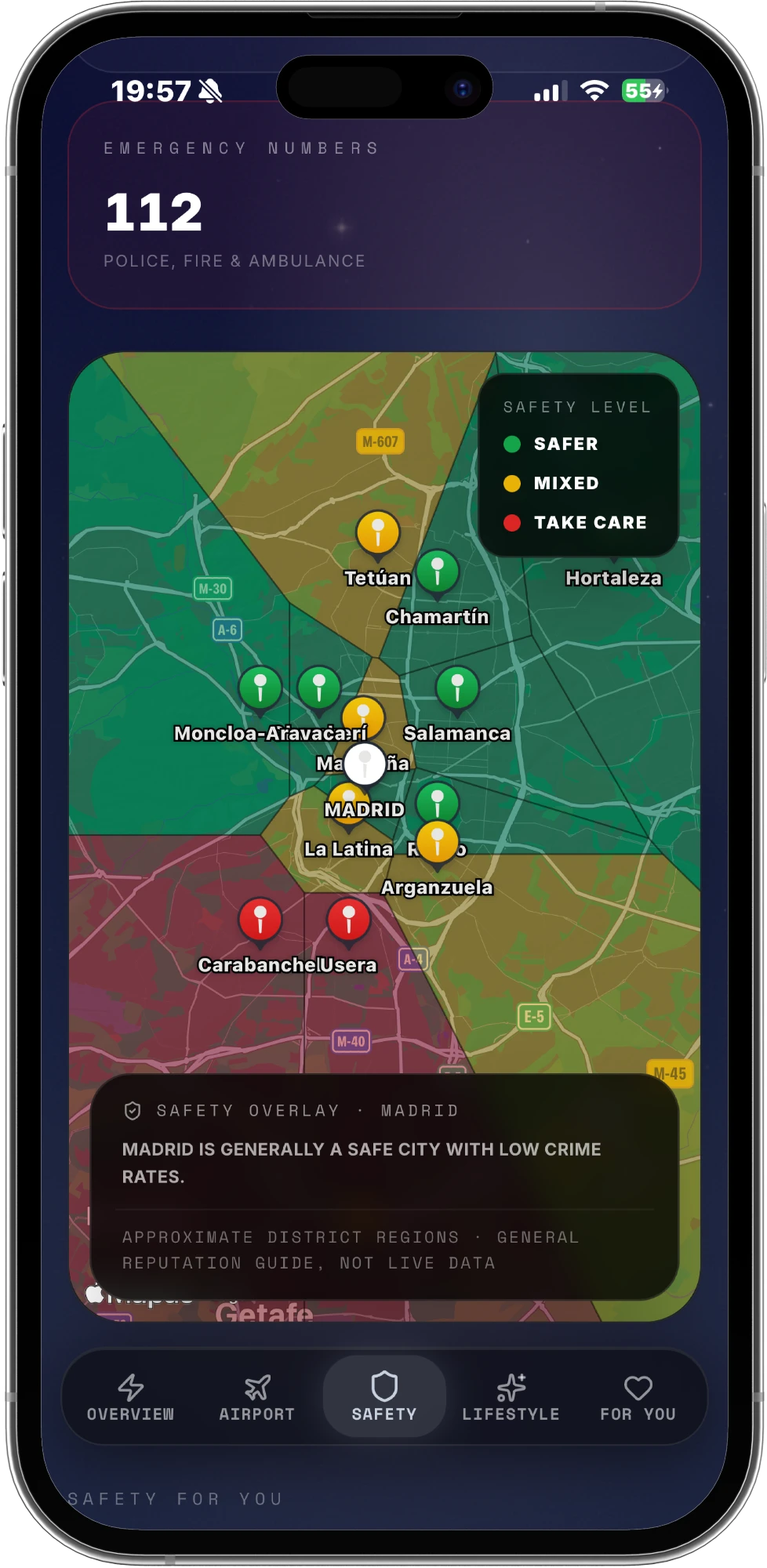
  3. A safety overlay for Madrid: districts shaded green, amber and red with pins, the local emergency number 112 at the top, and a caption noting the regions are approximate and not live data.

    Safety

    Not the country. The street.

    A national advisory tells you nothing about the eight blocks you booked. Velora reads a city district by district, keeps a second map for after dark, and puts the local emergency number on screen before you need it.

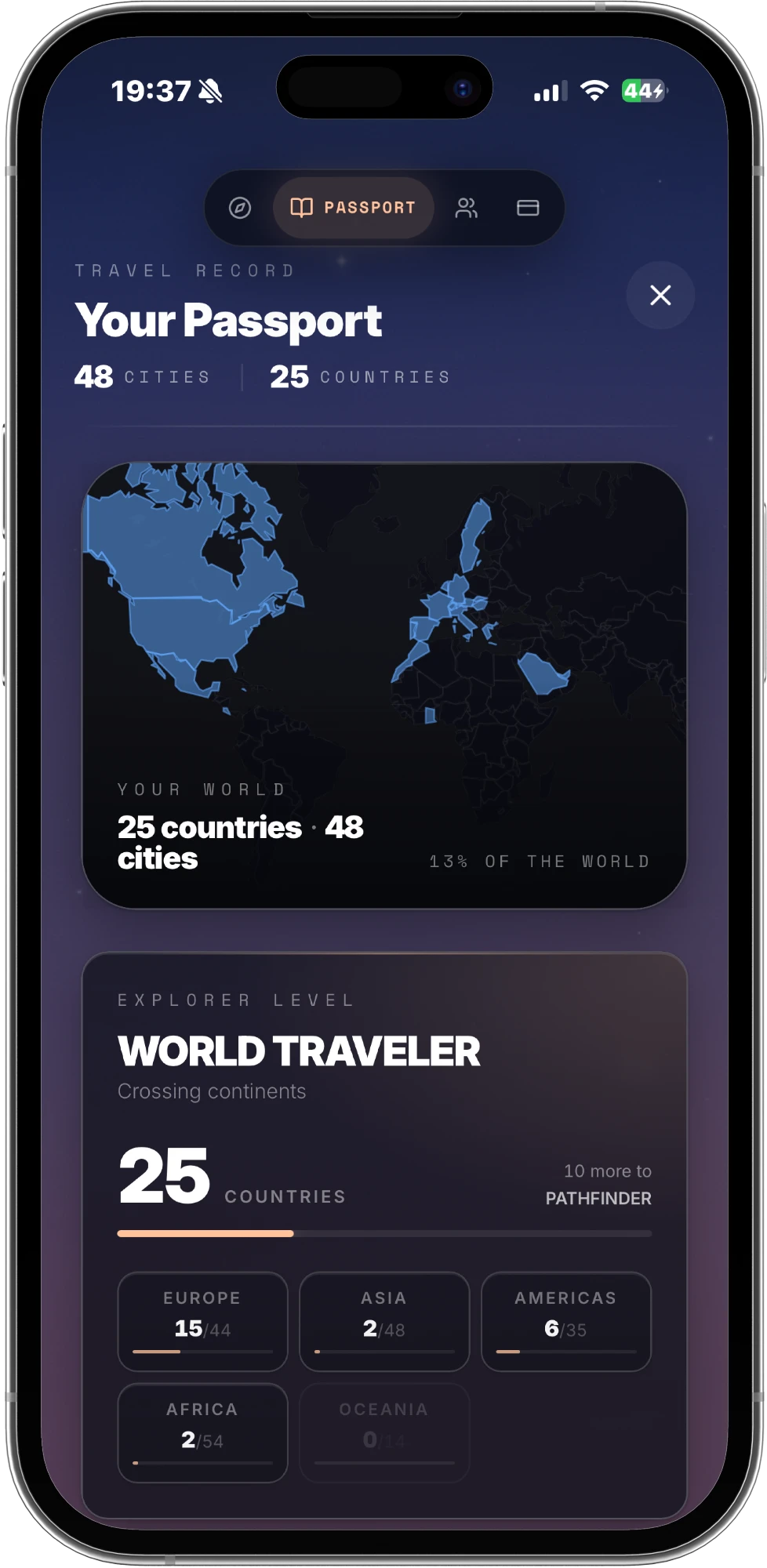
  4. A travel record: 48 cities across 25 countries on a world map, an explorer level of World Traveler, and per-continent counts.

    Passport

    Every city you have stood in.

    Cities stamped, countries covered, the share of the world you have actually been to. A record rather than a scoreboard, and what the briefs read to know who is asking.

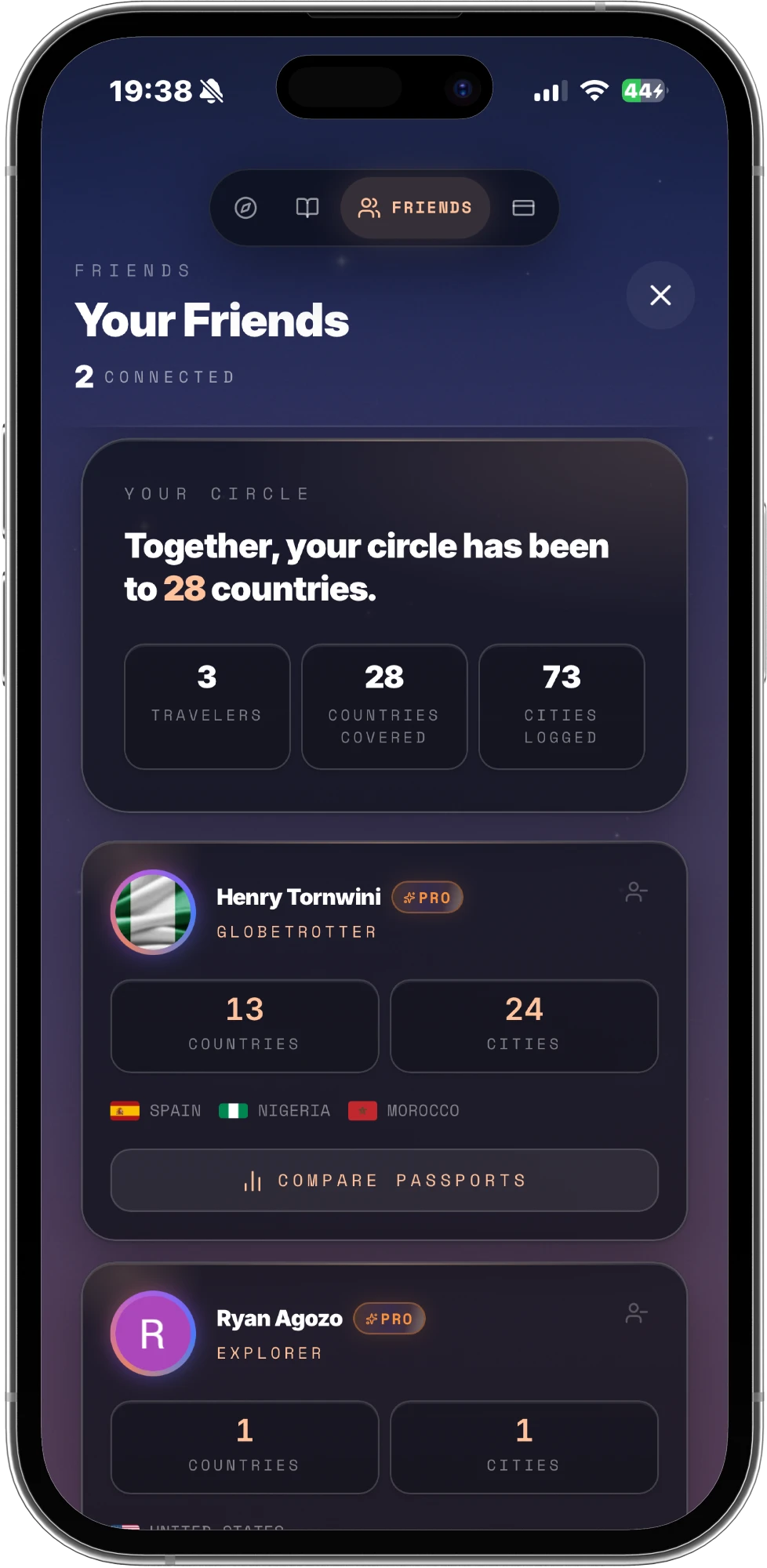
  5. A friends view: the reader's circle has been to 28 countries across 73 cities, with each friend's country and city counts and a button to compare passports.

    Friends

    A friend who has been is an answer.

    A stranger's review is a data point. Put your passports beside each other, see who has already been where you are going, and ask the one person whose taste you actually know.

What is behind an answer

Nothing here is made up on the spot.

Ask Velora about a city and it is not going off to research one. The research already happened, city by city, and every fact was written down with the kind of source behind it and the date it was checked, most of them with a note on what they rest on and how confident that source is. All Velora does when you search is read it back.

49,732

Separate facts Velora can already answer from

Not visits, not impressions, not rows in a log. Individual things Velora knows, counted once each, every one of them already researched and written down before you searched. It arrives in two halves, and both of them are added up below.

6,623

Velora's own research

Spread across 95 cities, of which 80 are researched to the floor: every one of the 44 scored attributes present, none of them left to a guess. This half was built for Velora and is not downloadable from anywhere. It is the reason the app can answer at all.

  1. 4,645 Sourced facts about a city
  2. 1,312 Bars and clubs, each in a district
  3. 448 Nightlife districts they sit in
  4. 218 Quotes lifted from local sources
  • 2,192 from research
  • 1,148 curated
  • 1,105 official sources
  • 128 derived
  • 72 community reports
43,109

Compiled in, not called for

Open reference data, built into the app rather than fetched when you ask. A passport answer is a lookup in memory: no API in the way, no rate limit, no waiting on somebody else's service to be up.

  1. 39,601 visa answers, every passport against every country¹
  2. 3,262 airports, so Velora knows how you would actually get there²
  3. 246 countries' currencies, so a price is in money you recognise³
  • Every fact says what kind of thing it came from. Research, an official source, a community report. Each one is stamped with the date it was last checked, and where there is a link to keep, it is kept with the fact.
  • A blank is left blank. If a city has not been researched on something yet, Velora says so. It never fills the gap with a guess and hopes you do not notice.
  • The total is the parts, added. Everything above is counted once and shown once. If a figure here moves, the number at the top moves with it, because it is that sum and nothing else.

How the match works

A score that can tell you why.

Velora holds 35 numbers about you and 44 about each city, and compares them with 39 rules that each have a name and a reason. That matters for one reason: when a city scores 80 for you, Velora can say which parts of you it is answering. A model that guesses cannot.

What Velora knows about you

35

things, each one from an answer you actually gave. Nothing is inferred from what you looked at.

  • how fast you move
  • what you will spend
  • how much safety matters
  • food
  • nights out
  • crowds or quiet
  • and 29 more

What it knows about a city

44

things, each one researched and sourced, or else honestly marked as not yet known.

  • cost
  • safety by neighbourhood
  • food
  • how walkable
  • how far English gets you
  • how touristed
  • and 38 more

Not everything you tell it means the same thing

"I love a good night out" and "I will not stay somewhere unsafe" are different kinds of statement. A scorer that treats them the same is why most recommendations feel arbitrary. Velora sorts every rule into one of three kinds.

  1. Something you want can only help

    Care about food and find a food city, and the city gains a lot. Not caring costs it nothing at all. What you are indifferent to can never be held against a place.

  2. A level that has to match helps or hurts

    Too expensive is wrong, and so is too cheap. A backpacker in Geneva and someone after a nice hotel in a hostel town are both badly served, and both get marked down.

  3. A line you will not cross the only veto

    Used for safety and nothing else. The bar rises with how much you say it matters, and a city that falls under it gets told to you in words rather than quietly losing points.

Try it: one rule, both ends Berlin

What it does to Berlin's score
Strong lift
What Velora will tell you
"has the nights you are looking for"

Slide your own interest down to nothing and watch the rule stop mattering, even against a perfect city. That is the whole idea. Direction and strength are shown here; the weights behind them stay ours.

The useful part is knowing when to shut up

One lucky fact can average a barely-researched city out to a 94. That is not a good match, it is thin data getting lucky. Three things stop it before a score ever reaches you.

Thin research scores lower
A city Velora knows two things about is pulled back toward the middle no matter how well those two things went. A city that has been researched properly keeps its score. Confidence has to be earned before it is shown.
You are told how sure it is
Low, fair or high, sitting next to every score. It takes the weaker of two things: how well Velora knows you, and how well it knows the city. Knowing you perfectly cannot rescue a city nobody has researched.
Nothing ever scores 100
No city is presented as a certainty or as a write-off, because neither is ever true. A product that shows you a perfect score is telling you about its own confidence, not about the city.

Why not just ask a chatbot

Because it will lie to you with a straight face.

It is the fair question, so here it is with real numbers attached. A general chatbot researches at the moment you ask, from whatever it happens to remember, and then tells you how confident it is in itself. Every one of those three is a place it goes wrong.

  1. A chatbot

    Gets under 40% of straightforward factual questions right, with nothing attached to tell you which 40%.

    OpenAI, SimpleQA, 4,326 questions

    Velora

    Every fact was looked up before you asked and names its source. If nobody has checked it, you are told that instead of being handed a guess.

  2. A chatbot

    Says it is 99% sure and is actually right about 65% of those times. Its confidence is not connected to its accuracy.

    FermiEval, arXiv:2510.26995

    Velora

    Confidence is counted, not felt. It comes from how much has actually been researched, and it goes down when the answer is thin.

  3. A chatbot

    Tested on real trips, it recommended a restaurant that does not exist and priced a train ticket at 62% under the real fare. Confidently.

    Forbes, on an InsureMyTrip test of three assistants

    Velora

    Numbers are read out of the database, not written fresh each time. There is nothing in the way for a model to invent.

  4. A chatbot

    Once travelers caught it getting travel facts wrong, they measurably stopped wanting to go where it suggested.

    Kim et al., Journal of Travel Research

    Velora

    Reasons quote research rather than generating prose. There is nothing to walk back later.

Speed is the same fact from the other side. A chat window starts reading when you open it. Velora's 4,645 facts were researched, sourced and checked long before you searched, so an answer is a lookup rather than a research session.

Velora's own accuracy has never been independently audited, and no figure claiming it appears anywhere on this page. What is claimed above is how it is built: where each number came from, and what happens when there is not one.

  1. Passport Index open dataset, snapshot 27 June 2026. github.com/ilyankou/passport-index-dataset
  2. OpenFlights airport database, snapshot 11 July 2026. github.com/jpatokal/openflights
  3. mledoze/countries currency dataset, snapshot 27 June 2026, ODbL. github.com/mledoze/countries
  4. OpenAI (2024), "Measuring short-form factuality in large language models." arXiv:2411.04368
  5. "LLMs are Overconfident: Evaluating Confidence Interval Calibration with FermiEval" (2025). arXiv:2510.26995
  6. Stoller, G. (2026), "How Accurate Is AI For Planning Travel And Vacations?" Forbes
  7. Kim, J.H. et al. (2025), "When ChatGPT Gives Incorrect Answers." Journal of Travel Research

Made to leave

The end of setup is something you would actually post.

Finishing setup does not drop you on a settings screen. It hands you a card with your own result on it, sized for a story, with a share sheet already open. Every Velora that gets set up is a card that goes somewhere Velora did not pay for.

A shareable traveler archetype card: Midnight Native, arrives when the city wakes up, roughly one in twelve travelers, with the reader's best-matching cities, Hong Kong 80, Taipei 80 and Tokyo 79, and an 85% match.

Your type

Everything Velora learned about you comes back as one named type, how rare it is, and the three cities that fit you best with the score each one got.

A shareable passport card: 25 countries explored, 13% of the world, 50 cities across 4 continents, a dotted world map with every visit pinned, and the reader's five most explored countries.

Your passport

Everywhere you have actually been, drawn as something worth sending. Countries, cities, continents, the share of the world you have covered, and every trip on the map.

Early

Start your account now.

Velora is in development for iOS. Creating an account now claims your Velora ID and puts you at the front of the line on launch day.

or

Already have an account?

By creating an account you agree to the Terms and the Privacy Policy.

Your account

You're in.

Velora is in development for iOS. Your Velora ID is claimed and your place in line is held, there is nothing else to do here.